SAGE: A Top-Down Bottom-Up Knowledge-Grounded User Simulator for Multi-turn AGent Evaluation
Columbia University
Simulator 不能脱离业务知识:Top-down 用 ideal customer profile / persona 灌入业务逻辑,Bottom-up 把 agent infra 的商品目录、FAQ、知识库灌进 simulator,让用户 "知道自己要什么、要怎么问"。比基线多发现 33% 的 agent error。
核心思路
问题:多轮交互式 agent(客服、销售、导购)难评测——靠真人成本高、不可规模化;现有 user simulator 要么依赖稀缺的真人对话数据,要么用 prompt 造一个”通用闲聊用户”,提的问题脱离具体业务,导致评测时触发不到真实 bug。
关键 idea:真实客户的行为由两件事决定——他是谁(角色、画像、购买力)和他想要什么信息(公司特定的产品知识)。SAGE 据此把两路业务知识灌进 simulator:
- Top-down 知识:来自业务逻辑的用户画像。核心是 ICP(Ideal Customer Profile,理想客户画像)——firmographics(行业/公司规模)、决策权限、预算、deal stage 等营销维度,再叠加 Big-Five 人格 + 人口学的”个体差异”。让 simulator 演的是”对这家公司有价值的那类客户”,而不是泛泛路人。
- Bottom-up 知识:来自 agent 自己的基础设施(商品目录 SQL 库、FAQ、知识库向量库、库存表)。把 agent 看得到的同一份知识也喂给 simulator,让它”知道该问什么、期望得到什么答案”。这份知识在评测阶段还充当 LLM-judge 的 ground truth 参照,用来判 agent 回答是否 faithful。
两路知识融合 → 构造 task scenario → 驱动多轮交互 → LLM-as-Judge 抓错并聚合成 unique bug 列表。结果:交互更真实、更多样,且比无知识 baseline 多发现 25–33% 的 agent bug。
整体实现思路
SAGE 是一条无需真人数据的端到端 pipeline,分四步(见下图):
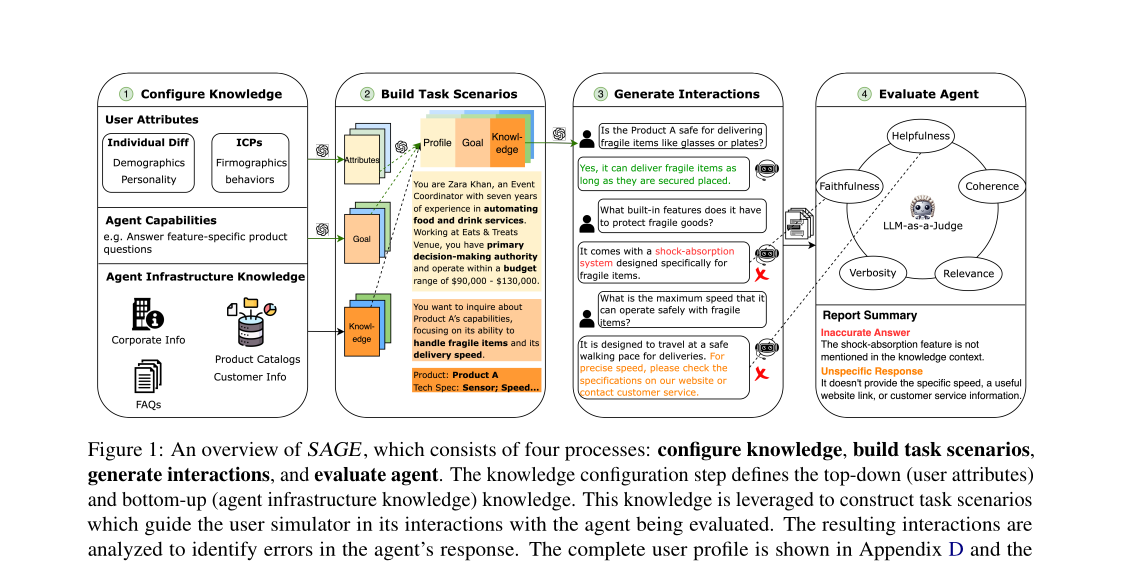
- Configure Knowledge(配置知识,§3.1):定义三类输入——① user attributes(个体差异 + ICP,可配置);② agent capabilities(公司给出要测的功能清单);③ agent infrastructure knowledge(结构化 catalog + 非结构化 FAQ/网页)。
- Build Task Scenarios(构造场景,§3.2):把 agent capability 用 LLM 翻成 user goal;按 goal 分层选一条相关 infra 知识;据知识 + 属性生成连贯 user profile;三者拼成自然语言 task scenario,作为 simulator 的 system prompt。
- Generate Interactions(生成交互,§3.3):simulator 与待测 agent 在共享环境里多轮对话。simulator 经 system prompt 显式接地于 infra 知识;agent 黑盒访问自己的知识。对话历史持续 append 双方上下文,直到 simulator 吐
###STOP###或达 turn budget。 - Evaluate Agent(评测抓 bug,§3.4):LLM-as-Judge 对每个 agent turn 五维打分;低分 turn → 两阶段聚合成 unique bug 列表 + 报告。
整条链路全部用 LLM 算子(goal 翻译、属性生成、profile 转写、对话、打分、聚错),零真人对话训练数据,对应”冷启动新 agent 没历史 log”的现实开发场景。
子模块实现(可复现细节)
1. User Attributes(top-down 用户属性)
两类,全部可配置:
个体差异(Individual Differences)
- Big-Five 人格:conscientious / extroverted / antagonistic / neurotic / closed-to-experience 五维各取值。
- 人口学:年龄、性别、教育、国籍/地点、婚姻、家庭规模、政治倾向等(沿用 Toubia et al. 2025 的 Twin-2K-500 体系)。
ICP(理想客户画像),按 B2B / B2C 分两套(Appendix B):
- B2B 属性(值集在括号内):customer type(new prospect / returning),discovery channel(search engine / third-party / friend rec / social media),budget,decision-making authority(primary / secondary),deal stage(new leads → demo schedule → after demo → decision make → contract sent → signed → paid),industry,company name,job information,company size。其中 authority、customer type、deal stage 是小而稳定的枚举值集;company name、industry、job information 这类动态生成(值太多无法穷举)。
- B2C 属性:复用 B2B 可迁移字段(customer type / discovery channel / budget)+ decision-making style(rational / intuitive),purchasing preference(discount / value / quality-oriented),spending behavior(5 档 tightwad–spendthrift 量表,Rick et al. 2008),loyalty level(loyal / neutral / disloyal)。
2. Agent Capabilities → User Goals
公司给出能力清单,LLM 把每条 capability 翻成一个 user goal(如”购买清洁机器人”/“询问某型号清洁效率”)。电商场景下按消费者决策模型分 5 阶段组织能力(Appendix C,Table 6),用 Verb–Object–Prepositional-Phrase(EARS 需求语法) 写成可测指令:
| 决策阶段 | 示例 agent capability |
|---|---|
| Need Recognition | 基于场景协助购买规划 |
| Information Search | 在给定品类/约束内推荐商品;回答 feature 级产品问题 |
| Evaluation of Alternatives | 提供商品对比 |
| Purchase Decision | 回答配送查询;回答折扣/促销查询 |
| Post-Purchase | 处理订单追踪;处理产品缺陷上报;处理退款/退货 |
遍历全部 goal → 保证对 agent 全能力面的覆盖。
3. Agent Infrastructure Knowledge Selection(分层选知识)
输入:一个 user goal。目标:选出既相关又多样的一条 infra 知识。
- 知识按 category 组织(FAQ / product catalog / …),每 category 含多条 knowledge piece(SQL 结构化 / 向量库非结构化)。
- 第一层:LLM 给定 goal 选相关 category(如 goal 是”问折扣”→ 选 FAQ)。
- 第二层:在选中 category 内用聚类算法找最相关的知识簇(如”reward program / promo code”簇)。
- 多样性采样:从簇里采一条之前没用过的 piece;若全用过则簇内随机选一条。
4. Profile Construction(画像生成)
输入:选中的 infra 知识 + 用户属性 schema。输出:一段第二人称自然语言 profile。
- 每个属性是
key → (预定义值元组);无预定义值的 key(firmographics / budget / company name / job info)由 LLM 据选中的 infra 知识动态生成(prompt 见 Appendix G.1:给定 knowledge,一次生成num_personas套 business_type / company_name / job_information / company_size,要求 diverse 且与公司 overview 对齐,返回 JSON)。 - 联合选值保证一致性:所有 key 的值一次性联合生成,避免互相矛盾(job info 依赖 industry 与 company name)。另有一个 validate-attributes LLM 步骤:对每对属性判 Yes/No 一致性(例:“commercial cleaning 公司不会叫 Caesars Entertainment”→ No;“returning customer 不会处于 new leads stage”→ No)。
- 转写 prompt:第二人称,固定以
"You are <name> who is <TRAIT 1..5>."开头嵌入 Big-Five。Appendix D 的样例 profile 把 11 项 ICP/人口学属性串成一段连贯人设(如 32 岁 Event Coordinator、$90k–130k 预算、primary 决策权、new prospect / new leads stage)。
5. Task Scenario & Simulator System Prompt
最终 scenario = user goal + infra 知识 + user profile,用结构化模板拼成,外加行为规则。simulator system prompt(Appendix G.2)关键约束:
- 每次只生成一行用户消息,简短;不一次性倒出全部 instruction;
- 禁止幻觉:instruction 没给的信息(如 order id)就说”不记得/没有”,不编造;
- 不照抄 instruction,要用自己的话;按 background(job / household / 活动)个性化提问;按人格调语气;
- 模仿真人客户短句 + 偶尔 typo + 不完整句的 chitchat 风格,以提问开场;
- goal 满足后输出独立的
###STOP###结束。
6. Evaluate Agent(LLM-as-Judge + 两阶段聚错)
打分(Appendix G.3):对每个 agent 回复沿五维各打 0–4 分 + 理由:helpfulness、coherence、verbosity、relevance、faithfulness。faithfulness 的 prompt 额外注入 bottom-up {knowledge} 作为事实参照——这是 SAGE 相对纯 prompt simulator 的关键增益(不靠模型内部知识判对错)。评测模型 gpt-4.1-2025-04-14,temperature=0.1。
阈值:只保留得分 < 2 的 turn 视为问题 turn。阈值经人审标定(不同模型评分偏置不同,如 gpt-5 的 helpfulness 系统性偏低,需各自标阈值)。人审 50 条低分 turn → 94% 确含 bug;50 条高分 turn 仅 4 条有错。
两阶段聚错(Appendix G.4):
- 阶段一:LLM 据问题 turn + 理由生成高层失败类目(Unspecific / Inaccurate / Incomplete / Irrelevant / Repetition 等),返回 JSON。
- 阶段二:给定类目 + 理由,去重成 fine-grained unique bug statement(明确指令”不要再用 helpfulness/coherence 这些维度,要落到 agent 具体行为,每条缺失信息算一个独立 bug”,附 item_id),如”did not provide weight capacity for Product_A when explicitly requested”。
- 最终输出 bug 列表 + 各 bug 关联 turn 的报告。
LLM 抓 bug 质量验证:对同 50 条低分 turn,LLM bug 列表 vs. 三位人类专家 → precision 0.73 / recall 0.74 / F1 0.73 / accuracy 0.74;专家间一致性 Fleiss’ Kappa = 0.85。
实验设置与结果
两个待测 agent:① 机器人公司生产环境部署的 RAG 销售 agent(用技术 catalog + FAQ + 企业信息答产品咨询,目标是最大化 lead conversion);② Shopify 上的 Tool-augmented 导购 agent(集成 13 个 API:get_recommendation / get_user_info / get_product / return_item / cancel_order 等 + FAQ/店铺政策)。
两条消融基线(对应两个假设 H1/H2):
- w/o ICP:去掉 top-down ICP,只留个体差异 + bottom-up 知识——对标 τ-bench / CRMArena 的 prompt simulator。
- w/o Agent-Infra:去掉 bottom-up infra 知识,只留企业 overview + top-down——对标 DuetSim 这类纯 persona simulator。
模型:gpt-4.1(正文);gpt-5 / gemini-2.5-flash / Qwen2.5-7B-Instruct / Llama-3.3-70B-Instruct(附录)。每条件每 use case 生成 150 段交互;真人交互从生产 log(2024.07–2025.07,英文,按 lead conversion 分析保留 3–15 turn 区间,该区间转化率 >20%)采 150 段。
指标:① 词汇多样性(reference-free:MTLD / HD-D / logTTR / rootTTR / vocab size / distinct@1-2-3,越接近真人越好);② simulator fidelity(人评 3 点 Likert × 4 维:human-likeness / coherence / specificity / consistency);③ 发现的 unique bug 数(越多越好)。
词汇多样性(gpt-4.1,Table 1,加粗=最接近真人)
| Method | MTLD↑ | HD-D↑ | logTTR↑ | rootTTR↑ | Vocab↑ | Distinct@1/2/3↑ |
|---|---|---|---|---|---|---|
| RAG 销售 agent | ||||||
| w/o ICP | 81.43 | 0.86 | 0.77 | 11.58 | 1011 | 0.21/0.60/0.81 |
| w/o Agent-Infra | 80.76 | 0.85 | 0.76 | 10.65 | 973 | 0.18/0.55/0.76 |
| SAGE | 86.05 | 0.86 | 0.78 | 11.80 | 1034 | 0.21/0.61/0.82 |
| Tool 导购 agent | ||||||
| w/o ICP | 76.52 | 0.86 | 0.75 | 9.88 | 907 | 0.18/0.57/0.78 |
| w/o Agent-Infra | 81.59 | 0.86 | 0.75 | 9.82 | 953 | 0.17/0.56/0.78 |
| SAGE | 79.97 | 0.86 | 0.76 | 10.37 | 961 | 0.19/0.59/0.80 |
| Human(参照) | 86.84 | 0.87 | 0.84 | 20.62 | 1360 | 0.30/0.72/0.91 |
SAGE 几乎所有指标最接近真人(仅 Tool 场景 MTLD 例外)。注意真人 rootTTR(20.62)/vocab(1360) 仍显著高于所有 simulator——多样性仍有差距。
Simulator Fidelity 人评(RAG agent,gpt-4.1,Table 2;∗=对两 baseline 均显著 p<0.05,†=对一个)
| Method | Human-likeness↑ | Coherence↑ | Specificity↑ | Consistency↑ |
|---|---|---|---|---|
| w/o ICP | 2.38 | 2.75 | 2.80† | 2.88 |
| w/o Agent-Infra | 2.20 | 2.50 | 2.53 | 2.88 |
| SAGE | 2.58∗ | 2.85∗ | 2.75† | 2.88 |
| Human | 2.90 | 2.85 | 2.85 | 2.90 |
SAGE 在 human-likeness、coherence 上显著最优且最接近真人;specificity 上 w/o ICP 略高(说明 specificity 主要靠 bottom-up 知识);consistency 四者持平(该维度对知识注入不敏感)。整体 w/o ICP > w/o Agent-Infra,暗示对 RAG agent,bottom-up infra 知识比 ICP 更重要。
Unique Bug 数(5 次平均,Table 3 / Table 9 / Table 12)
| Simulator model | Method | RAG-based | Tool-Augmented |
|---|---|---|---|
| gpt-4.1 | w/o ICP | 29.0 | 14.4 |
| gpt-4.1 | w/o Agent-Infra | 13.6 | 13.0 |
| gpt-4.1 | SAGE | 38.6 | 18.0 |
| gpt-4.1 | Human(参照) | 14.0 | – |
| gpt-5 | w/o ICP | 27.4 | 19.2 |
| gpt-5 | w/o Agent-Infra | 14.6 | 17.8 |
| gpt-5 | SAGE | 28.8 | 24.0 |
| gemini-2.5-flash | SAGE | 27.8 | 24.2 |
| Qwen2.5-7B | SAGE | 20.6 | 21.2 |
| Llama-3.3-70B | SAGE | 23.2 | 21.2 |
结论:SAGE 在所有模型/场景下都抓到最多 unique bug,次优是 w/o ICP;去 bottom-up 知识掉得最狠(gpt-4.1 RAG:38.6 → 13.6)。SAGE vs. 次优 baseline 的提升约 25–33%(gpt-4.1 RAG:38.6 vs 29.0 = +33%)。值得注意:真人交互只暴露 14 个 bug,远少于 SAGE——说明 simulator 在 bug-finding 上可能比真人 log 更有效。
失败类目分布(Figure 2)
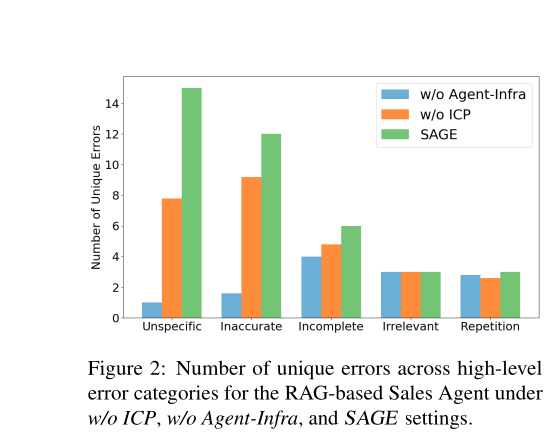
SAGE 抓到的错误集中在 Unspecific Response 与 Inaccurate Answer——正好对应 RAG 系统的核心失效模式(检索不准/不全)。w/o Agent-Infra 在这两类几乎抓不到错,印证 bottom-up 知识是触发”信息检索类”bug 的关键。另:绝大多数 error 出现在第一轮之后(Incomplete / Irrelevant / Repetition 尤甚),说明多轮评测不可替代(与 “LLMs get lost in multi-turn” 一致)。
案例(Table 4/13)
同一 goal”对比产品”下:SAGE 是唯一触发 agent error 的条件——抓到两个 faithfulness 错(agent 谎称 Product_A “适合户外/3 小时充满”,实际是室内用、需 5.5 小时)。第一个错由 top-down ICP 知识驱动的”农业户外适用性”提问触发,第二个由 bottom-up 知识驱动的”充电时间”提问触发——两路知识各自能逼出不同类型的错。w/o ICP 用泛化 persona → 重复/通用提问、轨迹不多样;w/o Agent-Infra → 提了与场景无关的问题(拿一台做餐饮的 Product_B 去问农活)。
思考与可参考价值
局限(含作者自述):
- 预定义属性源自面向客户的 business logic,内部 agent(教育/开票/后台)需自行重定义属性。
- 一个 task scenario 只含单 goal + 单条 infra 知识,无法覆盖真人在同一 session 内切话题的复杂轨迹。
- 强依赖业务侧已有结构化知识(catalog/FAQ);ICP 设计仍需人工。
- 评测是冷启动设定,无真人参照对比;多样性只用了 reference-free 词汇指标,fidelity 靠人评——指标偏弱。
- 33% 的增益是 evaluation 视角(发现更多 bug),不直接等于 agent 训练增益;且 LLM 生成属性可能放大主流群体、弱化少数群体(作者在 Ethics 中承认)。
对电商/搜推/Agent 方向的可借鉴点:
- “双路知识接地”是可直接复用的工程范式:评测电商导购/客服 agent 时,把商品 SQL 库 + FAQ + 用户画像(ICP)同时灌进 simulator,能让模拟用户提”业务真问题”,精准压测检索/工具调用链路——比通用 user-bot 找 bug 多 25–33%。
- faithfulness judge 注入 ground-truth 知识:把 bottom-up 知识同时作为 judge 的事实参照,是治 LLM-judge 幻觉的实用做法,可迁到任何 RAG agent 离线回归。
- 属性联合生成 + 一致性校验两步,是生成”逻辑自洽 persona”的轻量方法,可用在推荐/营销的合成用户群体构造。
- ICP × deal-stage × spending-behavior 这套营销维度对电商尤其契合——按 deal stage / 购买偏好分层造模拟用户,能做漏斗各阶段的 agent 压测与覆盖率统计。
- **“simulator 比真人 log 更会找 bug”**的发现值得警惕也值得利用:simulator 可主动构造对抗/边界 query 提升 evaluation coverage,但要注意它不复刻真实流量分布,上线前仍需真人 log 校准。